Showing posts with label Article. Show all posts

Sunday, July 24, 2011

10 Non-Travel Resources To Help You Travel Better

Recently back from a long month of non-stop PV training in the mountains, my thoughts naturally turn again to travel... that bug is always lying dormant right there at the surface, & I'm fairly obsessed with each & every nuance of travel. I came across this article by Boots & All while browsing my Travel RSS, & found that the advice is not only helpful for planning a 'Round The World' (RTW) trip, but in the organization of everyday life. It's so helpful, in fact, that I felt the need to save & share it. Check it out ~ I bet it'll rustle your travel &/or organization bug, too:


10 Non-Travel Resources To Help You Travel Better: "

Planning a RTW trip is a time consuming process, and travelers are always looking for ways to make their planning and traveling easier. In this technological age we live in, there are countless resources that can help us stay organized while planning a trip of this magnitude, and there are plenty more to help us once we’re on the road for an extended length of time.


Being able to accurately keep up with the budget, storing photos and music and books online, backing up our computers, and keeping up with friends and family back home are all aspects of a RTW trip made easier by the advance in technology.


Not all of the following 10 items were made with travel in mind, but these tactics and resources can help any long term traveler stay organized and in touch while on the road.


1. Evernote


This list is not in order of awesomeness, but if it was, Evernote would probably be at or near the top. Tim Ferriss, author of the 4-Hour Workweek, referenced this app in his best-selling book. After checking it out and playing around with it, I am now addicted. You can access Evernote via a mobile phone app, on your desktop, and online.


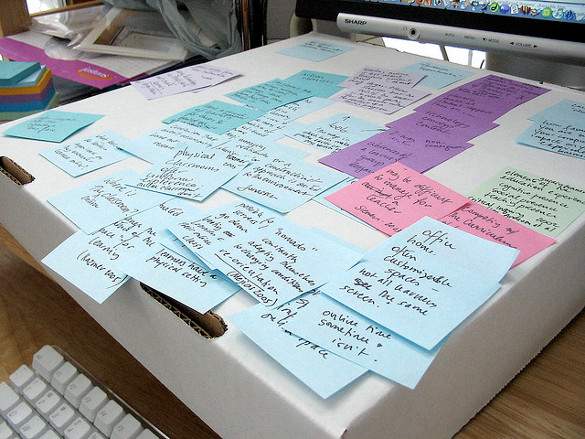
Evernote is basically a note-taking, organizational, and storage system that can hold just about anything. Snap a photo with your phone, upload to Evernote, tag it, and any word in the photo is searchable. You can snap pictures of things like business cards and even handwritten notes, and then store them in Evernote with appropriate tags to keep them organized. The words in handwritten notes are even searchable, and between that, the tags, and the various notebooks you can create, it makes it super easy to find anything you have uploaded, even when you have thousands and thousands of notes! No need for a mess of post it notes scattered about your home or office again.


For travel, this can come in handy in a variety of ways. Many travelers are constantly jotting down notes in random places-notebooks, guidebooks, random pieces of paper, napkins, whatever we can get our hands on. If traveling with a smart phone, you can get rid of all the paper clutter. Someone suggests a great hotel? Open the Evernote app, type the name in, tag it, put it in the appropriate notebook, and bang, it’s available via your phone, on your desktop, or online at your account on evernote.com. See a yummy looking menu while walking around? Snap a photo of it, tag it, and you have a reminder for later, complete with the menu and address. Evernote has changed not only how organized I am in my travels, but also in my daily life.

...see the rest of the article here.


Check out Boots & All @ www.bootsnall.com


Monday, August 2, 2010

How to Travel Outside your Comfort Zone

Does travel always equal going outside your comfort zone?

Particularly among those of us who travel extensively, there’s a temptation to draw the equivalence. While travel can present opportunities to escape the familiar, to experiment with new behaviors, and to subject yourself to vulnerability and emotional risk, it does not mean that once the backpack is strapped on, you have automatically departed your comfort zone.

We are not referring to Amazing Race-like stunts, or bungee jumping, skydiving or other extreme thrill-seeking travel feats. Instead, we are referring to the comfort zone of the cultural and interpersonal variety and the sorts of uncelebrated travel achievements of human interaction that push mental boundaries. This comfort zone is about overcoming fears of people and cultures different than our own – by doing more than just visiting ruins, churches and temples, mixing it up with the front desk staff of the hostel, and staring out the window of a spiffy tour bus while making grand philosophical projections about the life streaming by outside.

It’s about getting lost – sometimes physically, often times emotionally – and placing yourself in situations whose challenges spit you out on the other side – altered, slightly different, and just possibly a better person.

We’ve met travelers who would like to push themselves beyond the limits of what they know and understand, but they don’t know how to get started. We offer a few ideas on how to begin.

After this, you’re on your own. That’s when the real fun happens.


See the entire article here, on Uncornered Market.


Uncornered Market: Filed Under: Personal Growth, Travel by Daniel Noll and Audrey Scott

Tuesday, July 6, 2010

Solar Ovens: Hey, Hey Good Lookin', Whatcha Got Cooking?

Consumers increasingly seek greener energy sources while dreading the costs associated with special roof panels or windmills. Solar ovens represent one of the cheapest and easiest ways to go green. Box cookers, also known as solar ovens, often present no greater investment in time or money than a cardboard box, an old window, aluminum foil and a can of black paint.

History

In 1767, French-Swiss scientist Horace de Saussure created a solar box cooker that achieved temperatures of almost 190 degree Fahrenheit, according to a history of solar cookers compiled by the University of Vermont. Over the next 200 years, scientists and amateur inventors continued to make innovations on the design. In the 1970s, interest in the solar cookers reignited, especially after solar cooking advocates Barbara Kerr and Sherry Cole developed an easily-made version which could be constructed from simple household materials. Today, charitable organizations like Solar Cookers International work with Third World countries to promote solar cooking and to establish the practice in refugee camps and impoverished regions.

Solar Power Systems Find A Professional Solar Energy Installer For Any Type Of System www.CleanEnergyAuthority.com

Function

The simplest solar cookers feature a shallow, medium-sized wooden or cardboard box and a transparent covering. The oven works best if painted black on its exterior, because black best absorbs and retains the sun's rays. A reflective material, such as aluminum foil, lines the inside of the box to capture more sunlight, while the exterior works best if insulated. A box-within-a-box system can provide insulation, especially if you stuff the gap between the two boxes with newspaper. For optimum heat retention, some solar cookers are insulated with non-toxic materials and filled with air pockets, while others use angled reflective flaps to direct more sunlight to the solar oven.
Benefits

SCI points out that solar ovens preserve nutrients due to the lower cooking temperatures. Food rarely burns or dries out in the solar ovens, because their temperatures don't exceed 195 degrees Fahrenheit. Additionally, solar ovens help users conserve electricity, gas, wood or charcoal by forgoing the stove, oven, microwave or grill. SCI considers solar cookers safer than campfire or grills, because they eliminate the danger of structure fires or cooking, as well as the possibility of smoke irritating the eyes or lungs. At their most basic, solar cookers are relatively inexpensive, especially if self-assembled. Because of their low cost and simplicity, third-world countries increasingly utilize the cookers, which can pasteurize water and safely cook food. Finally, during days or months of adequate sunlight, solar cookers can be utilized during power outages.


Read more: http://www.livestrong.com/article/133034-information-solar-ovens/#ixzz0syaz73Ys

About this Author

Melissa Jordan-Reilly has been a writer for 20 years, both as a newspaper reporter and as an editor of nonprofit newsletters. Among the publications in which she has published are, "The Winsted Journal," "Taconic" and "Compass Magazine." A graduate of the University of Connecticut, Jordan-Reilly also pursues sustainable agriculture techniques and tends a market garden at her Northwestern Connecticut home.Article reviewed by Tad Cronn


Last updated on: 05/27/10

Tuesday, June 22, 2010

Solafrica Gets the World Cup to Africa's Slums With Solar Energy


Swiss-based, non-profit organization, Solafrica, brought the 2010 World Cup to Nairobi's largest slum by donating a portable solar station, and some much-needed technology.

Kibera--Africa's largest slum with a population of a million--is as manic about World Cup Football as the rest of the continent. But without electricity, not to mention television, watching any of the games has been out of the question.

That is, until Solafrica's latest contribution.

Working closely with the Kibera Community Youth Program and Greenpeace, Solafrica donated the solar power station, along with a television set, to bring people together to celebrate sport. A similar set-up was done in Jericho.

The power station is compact, easy to use, with minimal wiring, and is set up in a public hall that can house up to 1,000 people.


Read more of this story here.

By Harry Tournemille on June 22, 2010
Solar Energy: www.energyboom.com